Blog
By Adharvaa Developers · Rajanukunte, North Bangalore · Updated August 2026
Open Hesaraghatta Grassland at sunrise beside The Grasslands villa plots, Rajanukunte, North Bangalore
Most homes in Bengaluru look out at another building. A very few look out at open sky, tall grass moving in the wind, and a landscape that has stayed the same for centuries. The Grasslands, Rajanukunte is one of them — it sits beside the Hesaraghatta grassland, the last surviving grassland around Bengaluru, and one the Karnataka government has now formally notified as a protected conservation reserve.
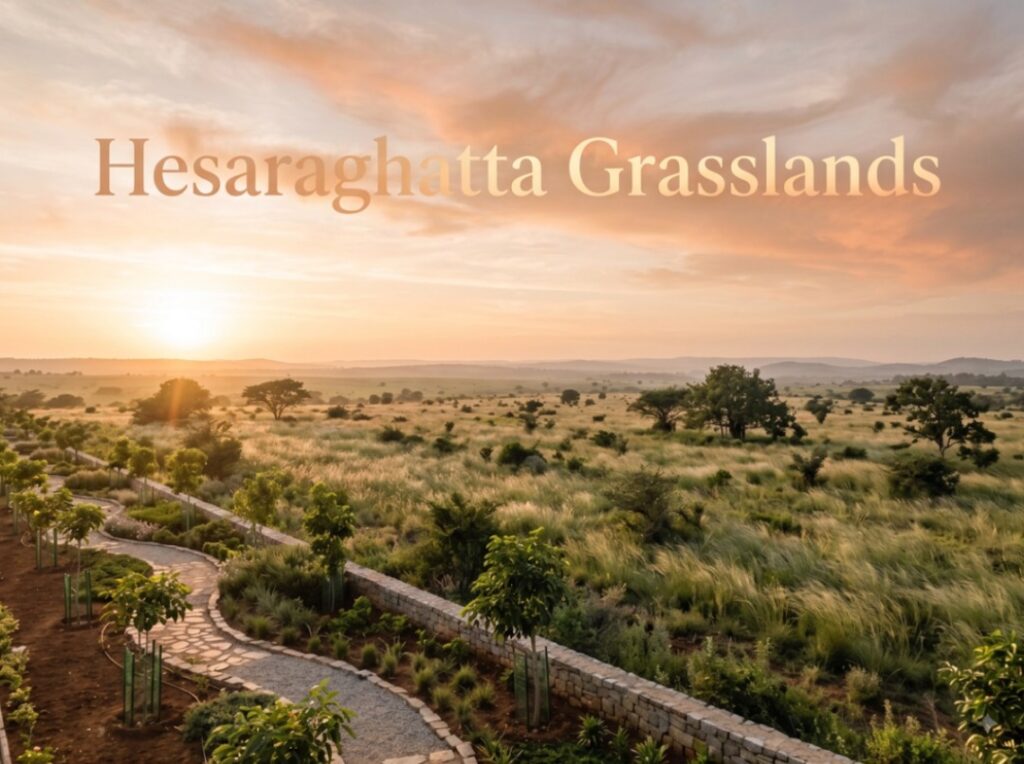
The Grasslands, Rajanukunte is a 130-plot gated villa-plot community on 8.04 acres in North Bangalore, located beside the Greater Hesaraghatta Grassland Conservation Reserve. On 24 February 2025 the Karnataka government notified 5,678 acres and 32 guntas of government land in Yelahanka taluk as that reserve under Section 36A of the Wild Life (Protection) Act, 1972. Because factories and large commercial construction cannot come up on notified reserve land, the open green outlook beside the project is protected by law rather than by a developer’s promise. The reserve covers government land only — privately owned, approved layouts such as The Grasslands are not acquired or restricted, and plots here are RERA- and BMRDA-approved, with clear titles, ready to register and build.
The Hesaraghatta grassland is the last surviving natural grassland around Bengaluru — open country, short grass, scattered scrub and a quiet that has almost disappeared from the rest of the city. It is what much of this plateau looked like two centuries ago, before the city grew outward. Ecologists describe it as Bengaluru’s second-largest lung space after Bannerghatta National Park, and it wraps around Hesaraghatta lake, the city’s first planned drinking-water source.
It is also a working piece of Bengaluru’s water system rather than an ornamental green patch. The landscape sits in the catchment of the Arkavathy river, the Thippagondanahalli reservoir and Hesaraghatta lake, and acts as a sponge that slows monsoon runoff and helps recharge groundwater for surrounding villages. That combination — rare habitat plus water security — is why the fight to protect it lasted more than a decade.
Yes. This is the single most important fact for anyone buying land nearby, and it is worth being precise about the sequence, because a lot of older marketing material still describes the reserve as “proposed”.
| Date | What happened |
|---|---|
| 19 January 2021 | The Karnataka State Board for Wildlife rejected the proposal to declare 5,010 acres at Hesaraghatta a conservation reserve. |
| 2021–2022 | Environmentalists challenged the rejection. The Karnataka High Court quashed the board’s order and directed it to reconsider the proposal. |
| 7 October 2024 | The State Board for Wildlife, chaired by the Chief Minister, approved the proposal and the draft notification. |
| January 2025 | The state cabinet approved the declaration and corrected the extent from 5,010 acres to 5,678 acres. |
| 24 February 2025 | The Government of Karnataka notified 5,678 acres 32 guntas in Yelahanka taluk, Bengaluru Urban, as the Greater Hesaraghatta Grassland Conservation Reserve under Section 36A of the Wild Life (Protection) Act, 1972. |
Timeline of protection for the Greater Hesaraghatta Grassland Conservation Reserve. Sources listed at the end of this article.
A conservation reserve is a protected-area category under the Wild Life (Protection) Act, 1972, declared by the state over government-held land to protect a landscape, its flora and its fauna. Once notified, the area is managed for its ecology through a Conservation Reserve Management Committee that advises the Chief Wildlife Warden. In plain terms: on that land, factories, large commercial buildings and industrial projects do not come up. The state has explicitly framed the notification as a way to curb encroachment and protect the catchment, not to displace people living around it — the Forest Minister said publicly that the declaration would not disrupt the life or livelihood of residents in the area.
That is the difference between a green view and a protected green view. Across most of Bengaluru, the open field opposite your plot is somebody’s future project. Here, the open land beside the layout is notified government land under a wildlife statute.
A great deal, and that is exactly why it was worth protecting. Records cited when the cabinet cleared the reserve list 285 species of birds, 111 butterflies, 13 amphibians and 395 insects, alongside larger fauna including leopard, jackal, fox and the slender loris. Smooth-coated otters are seen along the lakeshore and raptors work the open sky above the grass.
Two returns tell the story better than any list. The lilac silverline, a butterfly, was rediscovered in this landscape in 2012 after roughly a century unrecorded. The lesser florican — a globally endangered bird found only in India — was photographed here after a similar absence. A new beetle species has been described from these grasslands. This is not a landscaped park; it is a functioning ecosystem that happens to sit at the edge of a city of thirteen million.
It matters ecologically that Hesaraghatta connects toward other green corridors — Nandi Hills, the Hoskote grassland, the Jarakabande forest. Those corridors let birds and animals move, and they give a fast-urbanising Bengaluru a measure of climate resilience. Living beside that network is, quietly, being on the right side of the city’s future.
No. Conservation-reserve protection under Section 36A applies to government land. Private, approved layouts beside the reserve are not acquired, and there is no restriction that stops an owner registering a plot or building a home. The Grasslands, Rajanukunte is a private, RERA- and BMRDA-approved villa-plot community with 100% clear titles, ready for registration and construction.
During the long campaign for the reserve, a wave of misinformation circulated suggesting private land would be taken away — environmentalists working on the proposal publicly corrected it, and the government reiterated the point at notification. The protective layer sits on state-held land. Your plot remains yours: you register it, you design your villa, you build at your own pace.
The practical result is the combination buyers rarely get. A plot you fully own and can build on, next to a green expanse the law keeps open. You are not paying a premium for a view that a rezoning decision can erase in five years.
There is a common assumption that land this open must be two hours out. It isn’t. The Grasslands sits about 2 km from Rajanukunte, an established node on North Bengaluru’s map, inside the city’s fastest-growing corridor rather than at its far edge.
| Destination | Approx. drive time | Why it matters |
|---|---|---|
| Rajanukunte town | ~2 km | Daily needs, banks, transport |
| Presidency University, SVIT Engineering College, TATA Institute | ~10 minutes | Higher education cluster |
| Orchids International School, Chiguru Hospital | ~10 minutes | Schooling and healthcare |
| Vishwaguru Basavanna Biodiversity Park | ~10 minutes | Everyday green space |
| Manyata Tech Park | ~30 minutes | Largest North Bengaluru workplace hub |
| Phoenix Mall of Asia, Bagmane Sierra Business District | ~20–30 minutes | Retail and commercial anchors |
| Kempegowda International Airport (BLR) | ~40 minutes | The corridor’s growth engine |
Approximate drive times from The Grasslands, Rajanukunte. Times vary with traffic; confirm on your site visit.
Inside the community, the planning leans into the setting rather than fighting it. Tree-lined avenues and landscaped open spaces, nature walking trails, a bird-habitat zone, a community fruit orchard, a Miyawaki plantation, a butterfly garden and fragrance gardens — supported by the unglamorous backbone that makes it all work: RCC roads, underground utilities, a water-distribution and sewage network with centralized treatment, stormwater management and rainwater recharge.
Day to day, it is smaller than the brochure language. Mornings sound like birds rather than horns. Children get grass instead of a parking podium. The evening walk happens under open sky instead of through traffic. In a city where most people buy a view of the opposite balcony, that is the whole point.
Stand on the plot, watch the light move across the grassland, and decide from there. Free site visit, master plan and current price list.
Yes. The Government of Karnataka notified 5,678 acres and 32 guntas in Yelahanka taluk, Bengaluru Urban, as the Greater Hesaraghatta Grassland Conservation Reserve on 24 February 2025, under Section 36A of the Wild Life (Protection) Act, 1972. The State Board for Wildlife had approved the proposal on 7 October 2024 and the cabinet cleared it in January 2025.
No. The reserve protects government land. The Grasslands is a private, RERA- and BMRDA-approved villa-plot community with clear titles located beside that protected green belt. Your plot is fully yours to own and build on; the reserve keeps the neighbouring landscape open.
Not on the notified reserve land beside the project. A conservation reserve is a protected area under the Wild Life (Protection) Act, 1972, managed for its ecology, where factories, large commercial buildings and industrial projects are not permitted. That is why the open outlook here is expected to stay undeveloped.
No. The notification covers government-held land only. Private, approved layouts are not acquired and owners are not restricted from building. Misinformation on this point circulated during the campaign and was publicly corrected by the environmentalists who pursued the reserve.
About 40 minutes by road. Manyata Tech Park is roughly 30 minutes, Phoenix Mall of Asia and Bagmane Sierra around 20–30 minutes, and universities, schools and a hospital are within about 10 minutes.
Records cited at the time of the cabinet decision list 285 bird species, 111 butterflies, 13 amphibians and 395 insects, along with leopard, jackal, fox and slender loris. The lilac silverline butterfly was rediscovered here in 2012 after about a century, and the endangered lesser florican has also been photographed in the landscape.
Villa plots come in 30×40, 30×45 and 30×50 dimensions plus custom sizes, across 130 plots on 8.04 acres. Prices start from ₹59 Lakhs. Call +91 9901071239 for the live master plan and current price list
Yes. The project is RERA approved and BMRDA approved, with 100% clear titles, and is ready for registration and construction. Verify the current RERA registration number on the Karnataka RERA portal and check the Khata status at your site visit.
Adharvaa Developers, a North Bangalore developer operating since 2005 with 200+ families settled across its layouts, known for transparent, no-middlemen plot sales. Call +91 9901071239 or WhatsApp +91 89517 75999.
© 2026 Adharvaa Developers. All rights reserved.